|
2k. Describing the general structure and explaining the properties of ionic
compounds in relation to their structure e.g. giant ionic lattice
Using the ionic bonding models described
[Author
©
Dr Phil Brown GRIC, PhD:
Doc Brown's chemistry exam revision notes on
the
structures and properties of ionic
compounds,
suitable for students of UK GCSE Science level
AQA, Edexcel, OCR, WJEC and CCEA GCSE chemistry
courses, ~US grades 9-10 chemistry, also useful for more advanced
pre-university A level chemistry courses
[ionic bonding page updated RE-EDIT]
GCSE Foundation
tier (easier)
m/c QUIZ on structure, properties & chemical bonding
of materials
GCSE Higher
tier (harder) m/c QUIZ on structure, properties and chemical bonding of
materials
Index for
ALL chemical
bonding and structure notes
All my
GCSE level chemistry revision
notes
All my advanced level chemistry revision notes
All my
structure and bonding notes
Part 2
Ionic Bonding: compounds and properties
email doc
brown
*
[privacy, cookies and disclaimer]
This is a BIG
website, you need to take time to explore it [ SEARCH
BOX]
 The
crystal structure and properties of
ionic compounds
Dot and cross diagrams are fine for showing the electronic
structure of the ions in a crystal lattice of an ionic compound, but cannot show
how the ions are arranged.
A 2D diagram of the ions gives a limited view of how
the ions are arranged in the crystal, but only a 3D diagram can show how the
ions are arranged in the solid ionic compound, but neither show any electronic
structure detail of how the ions were formed in making the ionic bond.
 electronic
diagram for NaCl
(1)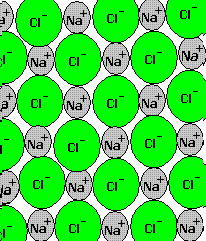 or the
simpler (2) 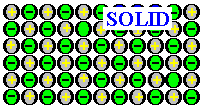 2D representations
(4)
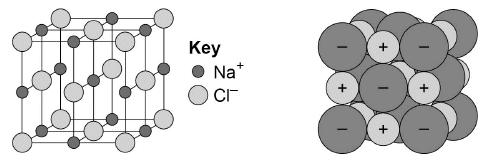 3D diagrams of
NaCl
|
Limitations of these
style of diagrams e.g. of sodium chloride, noting that none show
any electronic detail of the ionic bond |
| (1) A cross-section view
through the ions of a layer in the crystal lattice - it does show the
relative size of the ions |
(2) A simple 2D particle
model picture of the crystal, it gives no idea of the 3D arrangement or
relative size of the ions |
| (3) This shows the 3D
spatial arrangement of the centres of the ions in the crystal lattice,
but not their relative sizes. |
(4)This shows the 3D
spatial arrangement of the ions in the crystal lattice, and also the
relative size of the ions. |

A
GIANT IONIC LATTICE –
explaining its properties
- All ionic compounds have a very similar structure
and therefore very similar properties.
- The diagram on the right is typical of the
giant ionic crystal structure of ionic compounds like sodium chloride and
magnesium oxide.
- Solid ionic compounds consist of a giant lattice
of closely packed ions which are all combine together to form a crystal. You can
see in the right–hand diagram of sodium chloride, there is one positive ion to
one negative ion, giving the empirical formula NaCl.
- The (+) and (-) ions are held together by
electrostatic attraction.
- Same for KCl, MgO, CaO
- The ball and stick model is shown in the diagram on the right. Note that the
thin lines are NOT bonds, they just indicate the geometry of the crystal
structure. The electrostatic attractive force acts in ALL directions and that's
what the ionic bond is.
- This type of diagram does not show any electronic
detail of the ions, nor does it indicate the relative size of the ions
(governed by the space occupied by the electron clouds),
what it does show clearly is where the centres of the ions are positioned in
the crystal lattice - the 3D spatial arrangement of the ions with respect to
each other.
- The alternate positive and negative ions in an
ionic solid are arranged in an orderly or regular way in a
giant ionic lattice structure e.g. shown on the right.
- The ionic bond is the strong electrical attraction between the
oppositely charged positive and negative ions
next to each other in the lattice, so the electrostatic force of attraction in
ionic compounds acts in all directions.
- The ionic bonding extends throughout the crystal
in all directions.
- Salts and metal oxides
are typical ionic compounds.
- This strong bonding force between the
oppositely charged ions makes the structure hard (if brittle) and have
high melting and
very high boiling points,
so they are not very volatile!
- A relatively large amount of energy is needed to
melt or boil ionic compounds to reduce/overcome the strong bonding forces.
- The more kinetic energy
the particles need to overcome the strong ionic bonding forces, the higher the melting point
and boiling point, so most ionic compounds only melt and boil at relatively high
temperatures – a direct consequence of the strong chemical bonding in ionic
compounds.
- Energy changes for the physical changes of state
of melting and boiling for a range of differently bonded substances are compared in a section of
the Energetics Notes.
- The bigger the charges on the ions the stronger
the bonding attraction e.g. magnesium oxide Mg2+O2–
has a much higher melting point than sodium chloride Na+Cl–.
- The ions of magnesium oxide are both doubly
charged so the electrostatic attraction is much greater (its actually about 4x
as strong attractive force).
- As it happens in this case, the ions in
magnesium oxide are smaller than the ions in sodium chloride, so the ions in
magnesium oxide can pack closer together and this also increase the attractive
bonding force.
- This double effect results in a much stronger
ionic bond in magnesium oxide, so a much greater thermal kinetic energy i.e. a
much greater temperature, is required to weaken the giant ionic lattice and melt
the crystals of magnesium oxide compared to sodium chloride.
- Simple experimental evidence – sodium chloride
melts at 801oC, whereas magnesium oxide melts much higher at 2852oC.
- Unlike covalent molecules, ALL ionic compounds are crystalline solids
at room temperature.
- They are hard but brittle,
when stressed the bonds are broken along planes of ions which shear away.
- They are NOT malleable like metals.
Many ionic compounds are soluble in water,
but not all, so don't make this assumption.
- Salts can dissolve in water because the ions can
separate and become surrounded by water molecules which weakly bond to the ions
(see diagrams below).
- This reduces the attractive forces between the
ions, preventing the crystal structure to exist.
- Evaporating the water from a salt solution will
eventually allow the ionic crystal lattice to reform.
The solid crystals DO NOT conduct electricity
because the ions are not free to move to carry an electric current.
- However, if the ionic compound is melted or
dissolved in water, the liquid or solution will now conduct electricity.
- This is because the
ion particles are now free to move and carry the electric current in the
molten salt or the solution of the salt in aqueous solution (see diagrams
below).
- An electric current is the flow of charged particles
(ions or electrons) when a p.d. is applied via electrodes.
- This electrical conduction under these
conditions is evidence for the existence of ions in this type of compound.
- The melt or solution may undergo chemical
changes in the process called electrolysis.
-
Index of
electrolysis pages
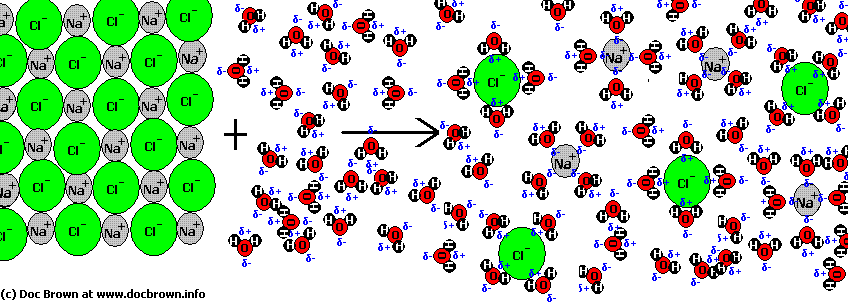
An 'advanced level' particle picture of sodium
chloride dissolving in water
BUT, in reality there wouldn't be as much
space between H2O molecules ...
(the partial electrical charges δ+ and δ–
are for advanced A level students only)
==>
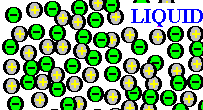
solid sodium chloride ==> molten sodium
chloride (from fixed ions to free moving ions)
|
Learning objectives to understand
the relationship between the structure of ionic compounds
and their related physical and chemical properties.
Be able to sketch a simple
'3D' style diagram to illustrate the idea of a giant ionic
crystal lattice.
Know that
the lattice consists of a symmetrical 3D array of
alternating positive ions (usually of a metal) and negative
ions (usually a non-metal).
Know that
the ionic bond is the strong electrostatic force of of
attraction between oppositely charged ions.
Know and
be able to explain why most ionic compounds have relatively
high melting points (e.g. compared to small covalently
bonded molecules).
Know that
a high melting point implies the ion particles must a high
vibrational kinetic energy to overcome the bonding forces
sufficiently for the crystal to melt. This argument applies
to the even higher melting points.
Ionic
compounds are often hard due to the strong bonding, but may
also be brittle at the same time as sheer forces can easily
cleave the layers of ions apart.
Know that
the solubility of ionic compounds in water is a complex
topic.
Sometimes
the ions are readily solvated (surrounded by loosely bonded
water molecules) and the salt dissolves in water e.g. sodium
chloride (common salt)..
In other
cases, the giant lattice forces are so great the ionic
compound is insoluble e.g. aluminium oxide.
Know that
a solid cannot conduct electricity because there are no ions
or electrons free to move through the giant ionic lattice.
Know that
when an ionic compound is molten or dissolved in water (e.g.
a salt solution) the liquid can carry an electric current as
the ions are free to move, this happens if a p.d. is applied
to the solution via two electrodes.
Positive
ions move to the negative electrode (cations to cathode)
Negative
ions move to the positive electrode (anions to anode).
Ions may
be reduced or oxidised to free the elements from the ionic
compound in a process called electrolysis.
Index of electrolysis pages |
What
next?
GCSE Foundation
tier (easier)
m/c QUIZ on structure, properties & chemical bonding
of materials
GCSE Higher
tier (harder) m/c QUIZ on structure, properties and chemical bonding of
materials
Sub-index for:
Part 2
Ionic Bonding: compounds and properties
Index for
ALL chemical
bonding and structure notes
Use Google search box
|
 For searching